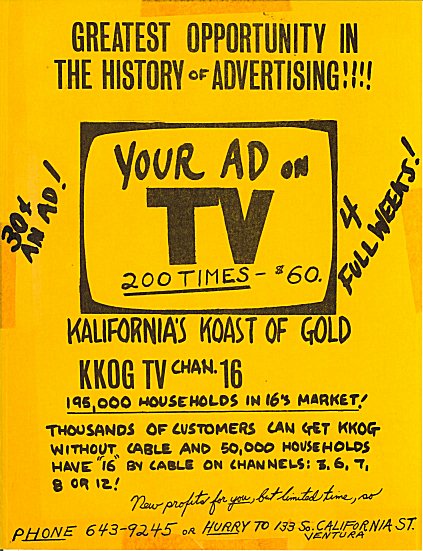
 As June, 1969 approached, having already slashed the regular commercial rate to $60 for 200 spots over a four-week period, Julian Myers faced the double dilemma of trying to attract both viewers and advertisers. Being the consummate innovator, he came up with a concept that he hoped would do both ...
KONSTANT KONTEST.
The way it worked was that every 20 minutes that channel 16 was on the air, with the exception of the weekly Church of Christ telecast, a traditional commercial break was replaced by a station staffer presiding over a wall of 11” x 17” posterboards, each of which displayed either a simple, uncluttered ad for a sponsor or the title card of a KKOG program. As the camera panned over the cards, lingering for several seconds on each, the staffer would ask a trivia question, and a few times in each two-minute Konstant Kontest segment would read written ten-second ad copy for the advertiser(s) being featured in that segment. If a viewer called in the correct answer, they could then select one of the cards on the wall, behind which would be a prize (worth “$3 or more”, by Myers' terms of participation) from one of the advertisers. Myers figured that in an average four-week period any given advertiser's card would be seen 420 times, for which they were charged $80 ... with a free bonus week of spots if paid upfront in cash. Although Konstant Kontest didn't save the station, it did prove popular enough to remain part of KKOG-TV's operation until the end.
Throughout the summer, more programs came and went. Gary Dyer tired of paying someone to manage his drive-in while he donned the Prince Gary costume for no compensation, and abdicated. He was replaced by an hour of filmed programming provided free of charge by industry, tourism bureaus, and the military. (Travelogues proved the most popular by those volunteer staffers who were running Master Control by then, even if KKOG was broadcasting them in black and white.) The country bands were now occupying a second hour every day but Saturday and Monday, and included the closest thing to a hit that channel 16 ever had ... the Galligan Family.
The Galligans -- parents Jim and Paulina, with brother Patrick and sister Bonnie Lue -- were a gentle, folk music quartet who arrived around the beginning of June and never left. An article in Broadcasting about KKOG (which we will see on the next page) described their act thusly: “The Galligans play guitar, sing folksongs, dance and invite viewers to sing along and make joyful music together.” The Galligans even made a special trip to the studios one August afternoon when a news crew from KNXT, the CBS-owned television station in Los Angeles, came by to film a faked broadcast day created for their benefit and interview Myers. It was through coverage of that event by Star-Free Press columnist Bob Holt (who was invited to watch the filming) that the harsh reality was made public: New Horizons Broadcasting owed the IRS $1,100 by August 15 and another $7,000 to $8,000 two weeks later. RCA, which hadn't been paid since May for its equipment, was demanding a $128,000 cash payment against the $228,000 owed to it. Myers himself estimated that an additional $50,000 in delinquent utility bills, lease payments, and the like existed.
Through it all, articles appeared in national publications highlighting KKOG-TV's struggles to make it with all-local programming in the face of network programming, old movies, and syndicated reruns from the Los Angeles stations. The National Observer, Variety, Newsweek, and even the Detroit Free Press shined their spotlight on this small UHF station in California, but if there was a knight in shining armor reading any of those articles, he didn't mount up and come charging in. Charles Champlin, the noted media critic for the Los Angeles Times, had devoted his column of April 17, entitled “Ventura's TV Station Picture Is Dimming” to a brief overview of the station's history to that point, ultimately concluding that “Ventura County's only television station is still live, still alert, and still local ... and trying desperately not to have been still-born.”
Through it all, Myers tried to be bravely optimistic. Holt quoted him as saying that “the guy next door is the most interesting person in the world in some field” and that his goal of making programs live, local and relevant to the audience had not changed. But he also conceded that KNXT and the six other VHF stations that Ventura County viewers preferred made the public indifferent about the existence of UHF, and that it would take at least another two or three years of promotion and education to get them to watch ... time he didn't have.
On the next page: Channel 16 goes dark.